

Contrast trim shirts: a complete guide
A key motivation guiding wardrobe choices is the desire for change and the longing for variety. Fashion is a healthy outlet for this fundamental human need. In an era where ties have receded, the shirt is the worthy successor for anyone looking to add a touch of personal expression to their daily outfit. Dress shirts worn day to day in an office or professional setting become part of a uniform. That white shirt or sky-blue shirt has become a marquee symbol of the working professional. Mass market shirt makers often make such shirts their flagship product and love them since they never go out of season or out of fashion. This breeds a conformity that stifles individuality.
Within the realm of business professional attire there is a room to depart from the uniform carbon copy feel of a plain white shirt and add a touch of color without standing out too much. Clothing is a form of creative expression. Between the daily grind and rut of commuting there is a place for a shirt that from a distance conforms to the professional environment that when looking closely contains unmistakable pigments of personality that distinguish it from those off the rack mass market office shirts.
If you want an office shirt that lets you bring your personality to the office, it needs to balance two competing priorities. On one hand needing to adhere to the dress code of a work environment and one the other allowing for individuality. Designing a shirt that balances these at times opposing forces requires threading the needle. Off the rack shirtmakers sell shirts that are indistinguishable replicas of each other. They conform to the first requirement but not the later. What you need instead is a shirt that from a distance looks no different than the other office shirts but up close has clear distinctions that lend personality to the shirt.
When designing shirts for such an audience there are a few levers we can pull to animate a business professional shirt. The first is weave. Many people do not realize it but there are many variations of white cotton shirting fabric. The default is plain weave white cotton shirting fabric which is a standard off the rack issue. As an alternative to plain weave, our herringbone shirts are popular. A herringbone patterns refers to rows of V shapes. The name derives from the pattern being evocative of a herring fish bone. Herringbone weave shirts can still be white but contain a more ornate texture. From a far it looks no different to every other shirt at the office but up close when meeting in person you see the individual.
Another lever one has at their disposal when designing shirts is the use of a second fabric inside the collar and cuffs. Doing so let’s you make a second texture visible on the inside of the shirt collar when unbuttoning the top button. This extends down the inside on the button stand of the shirt placket. Again, when unbuttoned a touch of flare becomes visible. This extends to the cuffs which are also inside only contrast. A great example of this is the herringbone white inside only contrast shirt. When buttoned up and at a distance this looks no different to every other plain white shirt in the office. When you roll your sleeves up for a more casual look the second fabric becomes visible. Up close you see a shirt distinct from the plain monochromatic white found off the rack.
You may wonder what is the point of an inside only shirt cuff. Why not make use contrast for the entire collar and cuffs? While white contrast is widely used, non-white contrast may go beyond the requisite conformity of many white-collar environments. Full contrast can really be an opportunity to animate a shirt but unfortunately but when the requirement is that from a distance it look like a plain white shirt worn by everyone else at the office then inside only contrast is a way to impart flavor without pushing the envelope too far.
When it comes to double cuffs you can render the second fabric visible without needing to roll your sleeves back. For French cuffs the cut corner style again comes in handy since the second fabric becomes visible when wearing them cuffed. For cocktail cuffs there is no need for a different style, the actual structure allows for the other fabric to be visible when at the underside when worn and fully buttoned.
A shirt can be further differentiated by the chosen cuff style. For a barrel cuff shirt, you can opt for a cut corner cuff which differs from the standard one button round cuff or one button square cuff. Other non-standard cuff options include the cocktail cuff or French cuffs which have become a rarity. Cuffs are a great place to invest in style since they are less prominent that the collar. They won’t be visible in a Zoom meeting or a headshot portrait. The number of buttons on the cuff can also be varied such as a two button versus one button cuff. Both are common in department stores so this by itself does not add much stylistic differentiation. Two button cuffs can also take more time to put on reducing functionality. Within an office environment where you might roll up and let down your sleeves throughout the day, this is a consideration. Another creative option is a convertible cuff. This is a barrel cuff with an extra button hole on the side with the button let you wear it as a French cuff. Such a cuff is very much in the spirit of a dual use shirt that can be worn both formally and informally. Even when not wearing it with cuff links the extra button holes can be a conversation starter. On French cuffs you can add an extra button hole for the purpose of letting you adjust the sleeve length slightly.
To tie the shirt together you can use a color for the buttonholes that is different than the main shirting fabric but similar to the second fabric used inside the collar and cuffs. For example, a white herringbone shirt with a blue checkered inside only contrast and navy button holes. To complete the set, mother of pearl buttons is used which are distinct from the plastic buttons used by mass market retailers. Contrast at the buttonholes really helps tie the shirt together by creating a bridge between the collar and cuffs. Apart from contrast buttonholes, contrast button stich is another decoration opportunity. When using contrast for the stitching the actual shape becomes apparent which most of the time is imperceptible. Four-hole buttons are typically sewed on in an x shaped stitching. When the thread used is a stronger color than the main shirt the shape of the stitching is revealed. A series of x’s running down the shirt placket and on either cuff. This leads to a more ornate shirt. The third ingredient of sewing buttons are the buttons themselves. The premium button to use, as mentioned, as mother of pearl. These are iridescent imparting an elegance and shimmering appearance. For luxury and premium shirts these are the go-to. However, when it comes to regular buttons there are many other options other than white. An orange, navy, red or blue set of buttons can further animate a shirt.
An additional optional stylistic ornament available is monogramming. Some people prefer monogramming; others find it pretentious. What many people don’t realize though is that monogramming does not need to be prominently visible. There are several possible locations depending on one desired level of prominence. You can monogram the left cuff, left chest near the breast pocket, inside the collar and at the waist. While most people might have a monogrammed cuff or chest in mind which are certainly very visible, you can monogram the inside of the collar or the waist instead. Instead of monogramming you can embroider your name. In the case of less prominent embroidery for example your name inside the shirt collar this can serve as a tag of label if you are concerned about your shirt being mixed up at the dry cleaner. Embroidery can serve a practical in addition to decorative purpose.
Beyond style and fabrics there is another dimension to differentiating from off the rack office shirts which is none other than fit. Standard sizing gradations don’t work for every individual especially those with non-standard body types such as big and tall or muscular body builders. Made to measure shirts can fit your unique physique and are a form of personalization. While it may not draw the eye the way a different colored button hole would, clothes that fit are visually distinguishable from clothes that don’t to say nothing of the benefit of comfort to the wearer.
All this to say, that a skilled shirtmaker can employ style, fabrics, weave, buttons, button holes, embroidery and fit to craft an office shirt that nods to both the individual wearing it and the surrounding corporate environment in a way that mass produced plain white shirts don’t. That is, the office shirt that allows for individuality.
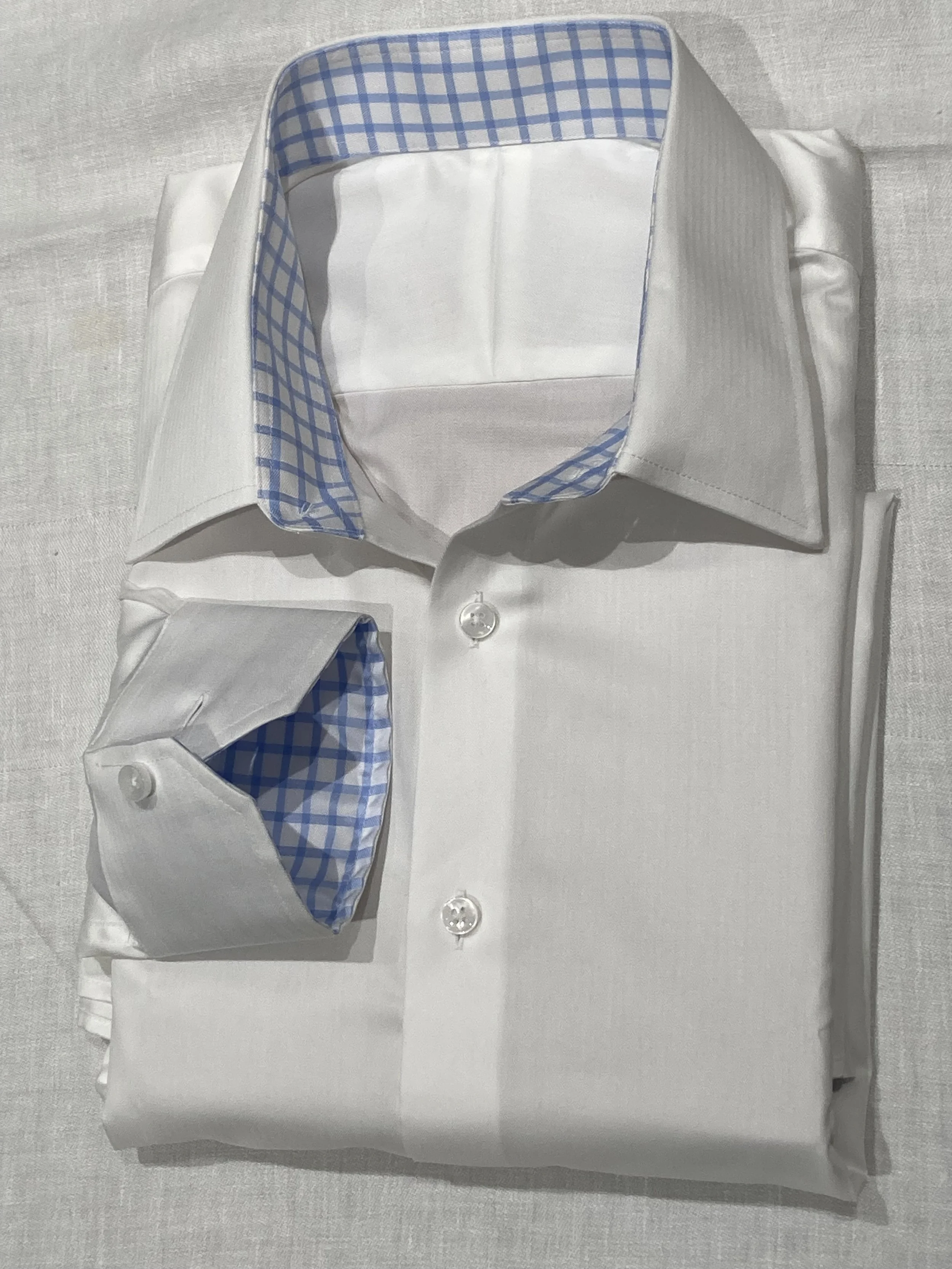
White narrow herringbone shirt with light blue check inside only contrast and mother of pearl buttons. 100% natural C4 cotton. Other features include split yoke, back pleats and removable collar stays. Two extra buttons included (one for the gauntlet and one for the main placket).
Collar: Classic
Cuffs: Round Barrel